U.S. Immigration and Customs Enforcement, also known as ICE, is a federal agency responsible for enforcing immigration laws. While its purpose is to regulate immigration, its actions often have serious consequences for marginalized communities. ICE operations have been linked to family separations, fear within immigrant communities and instability for students whose families may be affected. Even if an individual is not directly affected by these consequences, there are many ways that they can be secondarily impacted.
For many people, including students in our own school, this is not just a political issue; it is personal.
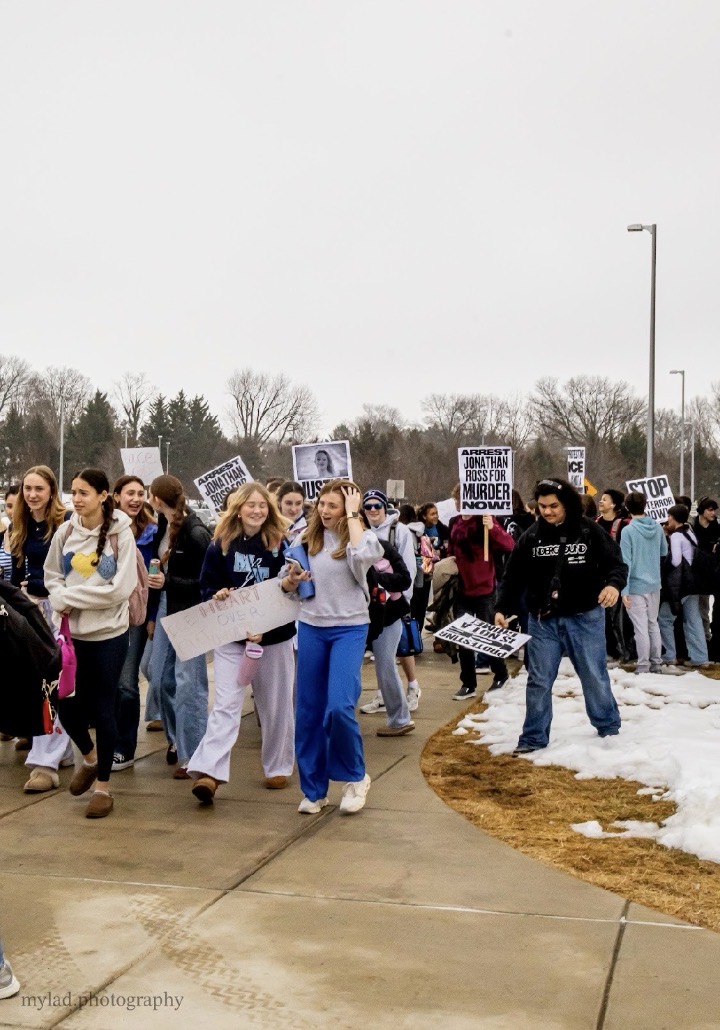
On Tuesday, Feb. 17, over 300 students chose to walk out of class to protest ICE and show support for those impacted by its actions. This was not an act of rebellion or violence- it was a collective decision meant to bring attention to an issue that affects real people in our community. However, administrators responded by assigning all participating students detentions for skipping a period, which is an overly simplistic response.
While it is true that students missed class time to participate in the walkout, labeling the action as “skipping class” ignores the purpose behind it. This was a peaceful protest, not an act of harm. Students utilized their First Amendment Rights of the U.S. Constitution to speak on an issue they care about: something education often encourages in theory. When students are taught about civic engagement and the importance of standing up for what they believe in, it seems contradictory to punish them when they actually do it.
Assigning the participating students detention has not only given them a feeling of failure in the administration, but also the sense that their voices are not being heard.
“We went through the proper actions to coordinate with the administration. We were open and honest about what we were doing and why,” said junior co-organizer Reagan Hawk. “Yet we still received punishment of afterschool detention. I don’t have a third period class, but was still punished for ‘skipping’…I felt unheard and ignored.”
Hawk believes that the punishment did not reflect the true meaning behind the action. Many students did not miss any academic time or were able to catch up on that single period that they missed. The point is that they make the choice to miss it. Hawk explained how it is unfair to assume that people were attending this cause solely to miss academics but were rather making a statement.
When over 300 people participate in something like this, it demonstrates that this concern is widespread. It is not just a small group acting out; it is a large portion of the student body expressing a shared perspective. That kind of response should be acknowledged, not dismissed through automatic punishment.
This being said, schools do need rules and attendance policies for a reason. Still, there is a difference between maintaining structure and failing to recognize context. Instead of assigning detention to everyone involved, the school could have taken a more thoughtful approach, such as attempting to understand why the students were motivated to do this, and a constructive compromise to their concerns rather than a simple dismissive act.
Ultimately, this situation is about more than just one disciplinary decision. It raises the question of whether student voices are actually valued. If students feel the need to disrupt the normal schedule to speak out, it means that they want to be heard. The walkout was an example of students trying to make their concerns seen, and that effort should have been met with understanding rather than punishment.